|
|
Tunis Ponsen (1891-1968)
Tunis Ponsen was born in Holland, but is considered an American painter. He especially worked in oils and watercolors, but also did a limited number of lithographs and linoleum block prints. He studied at the Art Institute of Chicago with George Oberteuffer and Karl Albert Buehr. He was a member of the Chicago Painters and Sculptors, Chicago Gallery Association, and the Chicago Society of Artists. Ponsen exhibited at the Art Institute [...] Click here to continue reading.
Alfred Kappes (American 1850-1894)
Predominantly a genre painter in New York City in the late 19th century, Alfred Kappes was elected an Associate member of the National Academy of Design in 1897. This same year, he exhibited Tattered and Torn at the Boston Art Club from January 14 to February 12. Kappes was renowned during his career for his sensitive portrayal of the lives of the African-American community, and was recognized as such in [...] Click here to continue reading.
Frank Townsend Hutchens (1869-1937)
The Norwalk, Connecticut impressionist Frank Townsend Hutchens studied with Irving R. Wiles and F.V. DuMond at the Art Students League in New York, and at the Julian and Colorossi Academies in Paris. He was a member of the Paris Association of American Artists, Taos Society of Artists, American Watercolor Society, Silvermine Artist Guild, and the Salmagundi Club.
Hutchens settled in New York City and in 1912, he moved to Norwalk, [...] Click here to continue reading.
Danish Silver
Under the Danish Hallmarking Act of 1893, the content standard for all silver was set at 826 parts out of 1,000, which is slightly lower than the standard for sterling which is 925. The remainder is usually copper with very small amounts of iron, lead and traces of other metals. The Danish mark, 826S was used until about 1915 when silversmiths raised their silver content to 830 and eventually to 925. Georg [...] Click here to continue reading.
George Rogers Clark (1752-1818)
George Rogers Clark was born near Charlottesville, Virginia, traveled west and settled in Kentucky in the early 1770s, despite the British prohibition of such western settlements. At the outbreak of the Revolution, these isolated outposts were subject to Indian attacks. Clark successfully lobbied the Virginia legislature to consider Kentucky a county of Virginia, which qualified it for governmental protection. Clark spent the duration of the Revolution running effective military campaigns [...] Click here to continue reading.
Clarice Cliff Delicia Wares
Delicia wares were produced in the early to mid-1930′s in a variety of colors with the paint is thinned down to allow it to run down the ware. At first technique was used to cover the entire ware, but later it was used with more restraint with several common decorative themes, including:
Delicia Citrus Wares, having naturalistic lemons and oranges with blue and green leaves above green and grey runnings. [...] Click here to continue reading.
Tea Leaf Ironstone China
By Thomas P. Heinecke
The origin of Tea Leaf china, like many other dinner wares commonly used in the United States during the 19th Century, can be traced to the United Kingdom and more specifically to the great pottery districts of Staffordshire including Stoke and Burslem.
Staffordshire had been producing large quantities of transfer decorated ironstone since the very late 18th Century for sale both at home and for [...] Click here to continue reading.
Weller Pottery ‘Forest’
Forest is one of Weller’s naturalist lines depicting scenes of forest and streams in relief, decorated in orange, blue, green and brown colors. Weller artist Rudolph Lorber designed Forest based on landscape observations he made from his window during a train ride.
Sugar Chests
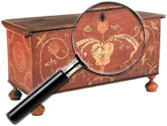
Sugar chests are generally a square or rectangular box on four tapered or turned legs; they were devoted to holding lump sugar – a scarce, expensive commodity in the backcountry during the early to mid-nineteenth century. Tennessee and Kentucky both lay claim to originating the form, and its variations include the larger sugar desk and smaller sugar case or sugar box. The overwhelming majority of sugar chests have locks, with cherry or [...] Click here to continue reading.
Coralene Decoration of Ceramics & Glass
Coralene describes a special decorating technique producing a raised or beaded texture used on fine glass and ceramic wares. It was popular during the Victorian era from 1850 to 1900, although it was also used in earlier periods by Japanese artisans and others and has been imitated in later eras.
Coralene decoration was applied primarily to premium wares like satin glass or peach blow because it involved three [...] Click here to continue reading.
|
Recent Articles
- Charles Alfred Meurer – American Artist & Tromp L’Oeil Artist
- Sendak, Maurice – American Artist & Writer
- Godie, Lee – American Artist
- Davis, Vestie – American Artist
- Bartlett, Morton – American Artist
- Mackintosh, Dwight – American Artist
- Evans, Minnie Jones – African-American Artist
- Mumma, Ed (Mr. Eddy) – American Artist
- Nice, Don – American Artist
- Savitsky, John (Jack) – American Artist
- Gordon, Harold Theodore (Ted) – American Artist
- Dial, Thornton – African-American Artist
- Doyle Sam – American Artist
- Johnson, Lester Frederick – American Artist
- Finster, Howard – American Artist
|
|