|
|
Chateau Leoville Las Cases
From a Skinner auction catalogue by Phil Minervino: “Leoville Las Cases is a St. Julien in name only — not that there is anything wrong with that. This wine is generally quite well-endowed and possessing dramatic depth. Leoville Las Cases is quite a large property on the river side of the north-south road from the city of Bordeaux. Leoville Barton and Leoville Poyferre were cleaved off at various times in [...] Click here to continue reading.
Chateau Pichon Longueville
From a Skinner’s auction catalogue note by Phil Minervino: “The visually stunning Pichon Longueville could serve as the post-card-image one conjures up when imaging a chateau in France. A Second Growth for certain, but given Pichon’s lofty neighbors, their competitive juices must be constantly flowing. An intriguing aspect with many these older, established estates is how rigorously they embrace modernity – one could be forgiven for erroneously assuming that time has [...] Click here to continue reading.
Invar
Invar, also called FeNi, is an alloy of iron (64%) and nickel (36%) with some carbon and chromium. This alloy is known for its unique properties of controlled coefficient of thermal expansion (CTE).
The Victorian Period, 1840 to 1890
Solely by being possessed of good genes and a solid constitution does Queen Victoria gain the distinction of having her name attached to one of the more interesting periods of history and furniture design. As an individual she lent little to the design field and with the exception of Gothic Revival at the beginning of the period and Eastlake at the end, Great Britain itself contributed little. France [...] Click here to continue reading.
Crocodile Inn Tavern Sign
(courtesy Sotheby’s)
More than 200 years ago, the painted wooden sign announcing Garret DeWitt’s Crocodile Inn hung in front of the DeWitt family home just south of Kingston, New York, on the road leading from the village of Hurley to the DeWitt gristmill on the Greenkill. The mill which was located immediately across the road from the house, was an important resource for Ulster County both before and after the [...] Click here to continue reading.
Bouillotte Lamp: A French table lamp, usually found with a painted metal shade, adjustable in height, on a brass dished base with one, two or three candleholders, were associated with ecard game. These popular lamps have been reproduced in the 19th and 20th centuries.
Right Bank, Left Bank
The chateaus Cheval Blanc and Petrus are two pillars of the “Right Bank”. This reference stems from the Bordeaux region being intersected by three rivers. The “right bank” of the Dordogne River is where the villages of St. Emillion and Pomerol are situated. Further to the north and west on the “left bank” of the Gironde River one finds towns such as Pauillac, Margaux and St. Julien. Right Bank wines [...] Click here to continue reading.
Boteh
A boteh is a somewhat kidney- or droplet-shaped figure used in Oriental rugs and textiles, from which the “paisley” motif is derived. Its origin has been a matter of speculation, probably Persia or India, and it is considered to represent both tangible items (such as a pear, a pinecone, a swaying tree, a palm or a leaf) to more mystical things like the “Flame of Zoroaster” or the “Tree of Life”.
Blanket Chest or Dower Chest?
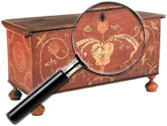
The rectangular wooden lift-top storage box is a widely identified furniture form often associated with Pennsylvania German decorative arts. Utilitarian in design, it features a lift top, iron hardware and usually rests on feet. The form was brought over from Europe and dates back to the Middle Ages. Sometimes referred to as a “dower chest” or “hope chest,” the preferred terminology is “blanket chest.”
A general confusion [...] Click here to continue reading.
Charles A. Lindbergh’s Atlantic Flight
The first nonstop trans-Atlantic solo flight was achieved by 25-year-old Charles Augustus Lindbergh between May 20 and May 21, 1927. He departed from Roosevelt Field, Long Island, New York in a highly modified version of a Ryan M-2 strut-braced monoplane, Spirit of St.Louis, and landed 33.5 hours later at Le Bourget Field, near Paris.
|
Recent Articles
- Charles Alfred Meurer – American Artist & Tromp L’Oeil Artist
- Sendak, Maurice – American Artist & Writer
- Godie, Lee – American Artist
- Davis, Vestie – American Artist
- Bartlett, Morton – American Artist
- Mackintosh, Dwight – American Artist
- Evans, Minnie Jones – African-American Artist
- Mumma, Ed (Mr. Eddy) – American Artist
- Nice, Don – American Artist
- Savitsky, John (Jack) – American Artist
- Gordon, Harold Theodore (Ted) – American Artist
- Dial, Thornton – African-American Artist
- Doyle Sam – American Artist
- Johnson, Lester Frederick – American Artist
- Finster, Howard – American Artist
|
|